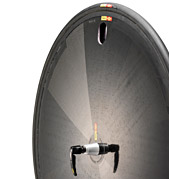
Quick definitions: A disc wheel has no visible spokes at all, a single solid or near-solid aerodynamic surface instead. A standard deep-section spoked wheel, even a very deep one like an 80-90mm aero wheel, keeps individual spokes and therefore some air passing through the wheel's structure.
What actually differs
What a disc wheel is actually solving
The archive review is specific about the tradeoff: a disc wheel earns its aero advantage from having zero spoke turbulence, and once rolling, the added weight actually helps maintain momentum rather than hurting it. The problem is getting that weight moving from a stop, and the fact that any crosswind, even a gentle one, hits a full solid surface instead of passing partially through spokes, which is a genuine handling liability at speed.
Why the archive review's honesty here is worth noting
A 2010-era product review calling its own subject unsuitable for training, road racing, or group rides, and explicitly narrowing it to time trials and triathlon, is unusually candid framing for a manufacturer-adjacent review of that era. It's also still accurate: current UCI rules and most triathlon federations treat disc wheels the same way, a specialist tool for a specific, controlled event, not a general-purpose upgrade.
A disc wheel fits you ifyou race time trials or triathlons on relatively flat, low-crosswind courses where mass-start rules don't apply, and you have a dedicated race-day wheel budget separate from your training wheels.
A standard deep spoked wheel fits you ifyou race mass-start road events where disc wheels usually aren't permitted, you ride varied terrain with any real crosswind exposure, or you want one wheel that works for training and racing both.