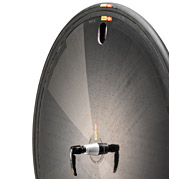
Short answer: the standard setup is a disc wheel on the rear paired with a deep-section wheel, roughly 60-80mm, on the front, with the front depth coming down as wind picks up. The watt savings and real prices are below, not repeated here.
Why the rear gets the disc and the front doesn't
A solid disc wheel is close to the aerodynamic ideal for a wheel that never has to turn. The rear wheel barely steers the bike, so it can afford to be a disc. The front wheel is what you actually steer with, and wind hitting it sideways is what can push a bike off line in a gust. That's why almost nobody races a front disc: a deep but still-spoked front wheel keeps the same aero shape without that handling risk, which is why a rear disc paired with a spoked front, not disc on both ends, is what shows up at almost every triathlon and time trial.
Rim depth by condition
The pattern below is simple even if the table looks technical: the calmer and flatter the course, the deeper you can safely go up front, because there's less wind to fight. The windier or hillier it gets, the shallower the front wheel should be, trading a small aero loss for a bike that's actually easier to hold steady.
| Course condition | Typical front depth | Rear |
|---|
| Flat, low wind | ~80mm | Disc |
| Moderate wind | 50-60mm | Disc |
| Strong, gusty wind | ~40mm | 60-80mm (non-disc) |
| Hilly course | ~50mm | ~80mm (non-disc) |
| All-around / one-wheelset riders | ~60mm | ~60mm (or a disc, if you already own one) |
Depth ranges reflect common patterns reported by Cyclingnews's and Elitewheels' own buying guidance for this category; a specific course's wind exposure and your own bike handling comfort matter more than treating any single number here as a rule. The hilly- course row drops the rear disc too, not just the front: extra climbing weight costs more over a long climb than the disc's aero edge is worth there, the same weight-vs-aero trade-off covered on wheel weight vs aero.
The watt numbers behind the disc decision, and where they come from
Per Quintana Roo's own aero-testing writeup on choosing a disc rear wheel (also published by Challenge Family), at a steady 40km/h a rear disc measures roughly 2-5 watts faster than an 80mm deep-section wheel, 5-10 watts faster than a 50mm mid-section wheel, and 10-18 watts faster than a shallow 30mm wheel, all else equal. One real caveat worth knowing: that advantage is biggest riding straight into a headwind and shrinks as wind hits the bike at more of an angle, so a disc's edge is smaller on a gusty, crosswind-heavy course than these numbers suggest on their own. Over a 40km time trial or the bike leg of a triathlon, even the smaller end of that range is a real, measurable chunk of total time, which is the actual case for a disc wheel rather than it being marketing.
What this actually costs
A new carbon disc wheel from a direct-to-consumer brand (ICAN, Carbonal, Elitewheels, Hunt) typically runs roughly $800-$1,600; established brands with a dealer network price higher, up to $3,000+. A deep-section front wheel alone is usually cheaper than the disc, often $400-$900 from the same direct-to-consumer tier. Used carbon disc wheels turn up on the secondary market from roughly $150-$800 depending on age and condition, a real way to try a disc before committing to a new one. None of this is a small purchase, which is exactly why the next section is about what to buy first if you can't afford both pieces at once.
One wheelset, not two: what to prioritize
A rider who owns only one triathlon/TT wheelset, and can't justify a disc, a deep front, and a backup all at once, should prioritize in this order: a disc rear first, since it's the single biggest aero gain for the money, then a 50-60mm front as the most weather-flexible depth rather than the deepest one available. Picking a wheel for the worst wind day you're likely to race in a gusty region is a safer default than picking for a calm best case. See race wheels vs training wheels for the broader version of this same question: whether a dedicated race-day wheelset is worth owning at all, based on how often you actually race.