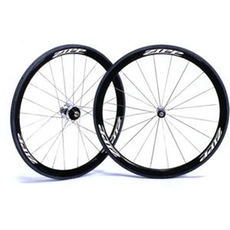
Quick definitions: A race wheel here means a wheelset chosen for its lowest achievable weight and best aero performance, ridden selectively on race days. A training wheel means whatever wheelset absorbs the bulk of a rider's actual mileage: commuting, base miles, group rides, bad-weather riding.
Why racers run two separate wheelsets
The case for two wheelsets isn't really about performance on any single ride, it's about matching each wheel's job to what it's actually built for. A race wheel's low spoke count and light rim are optimized for a short, hard, controlled effort, not for absorbing the potholes, debris, and sheer volume of a full training block. Running that same wheel every day either wears it out faster than it should, or means riding more cautiously than training actually calls for. A dedicated training wheel, built with a higher spoke count and a more field-serviceable hub, is the wheel built to take that volume without you thinking about it.
What you actually gain on race day
Independent aero testing (road.cc's own wind-tunnel and road testing, and Hambini Engineering's published wheel power data) puts the gap between a shallow alloy wheel and a deep aero carbon wheel at roughly 10 to 40 watts at typical race speeds of 30-45kph, with the gap widening at higher speed and narrowing closer to 1-2 watts per 10mm of added rim depth at more moderate paces. Translated to time: that's genuinely worth seconds to low minutes over a short, hard race effort or time trial. Over a long, moderate-pace training ride, the same gap barely shows up, which is the real argument for not putting those miles on the race wheel rather than saving it out of pure caution.
What training mileage costs a wheel
The wear that matters most is cumulative: more total braking cycles on a rim-brake wheel (heat is a genuine wear mechanism on a carbon brake track), more exposure to potholes and road debris on everyday routes versus a closed or controlled race course, and more chances for the ordinary dings, curb strikes, and garage bumps that happen on routine miles, not usually during a race effort itself. None of that is unique to race wheels specifically, but it costs more when it happens to the lighter, lower-spoke-count wheel built with less margin. See how long carbon wheels actually last for the full mechanism and realistic mileage numbers.
Archive price example: training-tier vs race-tier
A Shimano Ultegra WH-6700, described in its own archive review as "a reliable, good quality training wheelset," sold for about $650 in 2010. A full-carbon race-oriented wheel from the same era, the Reynolds Assault clincher, sold for about $1,500, roughly 2.3 times the training wheel's price for the weight and aero properties that matter most specifically on race day. That ratio has held up reasonably well into current retail pricing (alloy training wheels $300-$700, aero carbon race wheels $1,000-$1,800 at the accessible end). Keeping the pricier wheel off daily miles is as much about protecting that investment as it is about performance.
A second, dedicated race wheelset is worth it ifyou race regularly enough that a few race days a season justify the cost, you put real training volume on the bike between events, and protecting the wheel's resale value and lifespan matters to you.
One wheelset is enough ifyou race once or twice a season at most, your total annual mileage is modest, or you'd rather put the budget toward a single capable do-it-all wheel. See
touring vs racing wheels for how to pick that one wheel well.